Walk the old section first. What forty winters do to marble, bronze, and granite
Marble sugars, bronze loosens at the anchors, granite dulls on the shaded face. What decades of frost, mowers, and rain reveal about a material before you buy it.
choosing, pricing, and installing cemetery grave markers and monuments
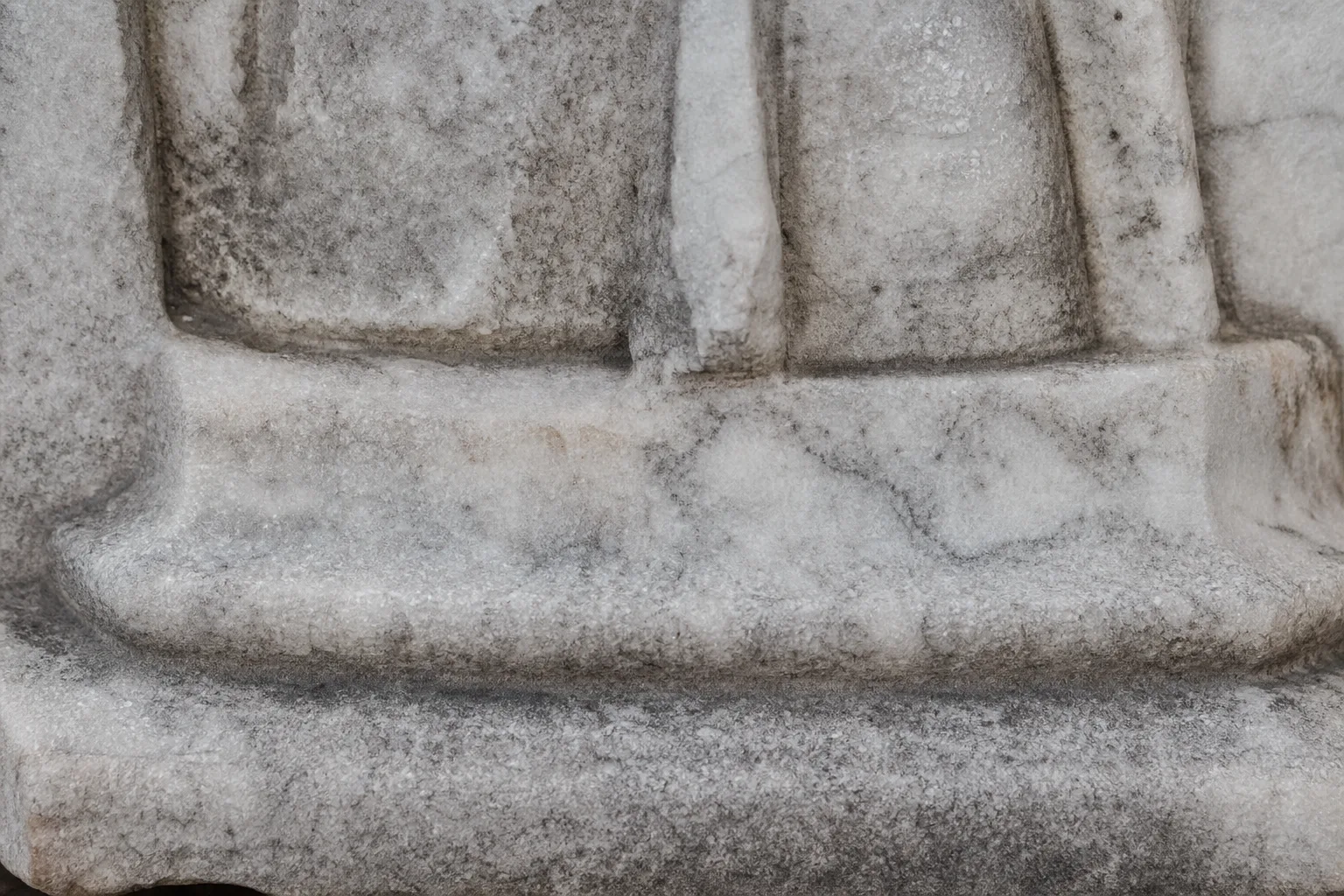
Marble is calcite, which dissolves slowly in mildly acidic rain, leaving a grainy chalk-like surface. The change usually starts on weather-facing and horizontal surfaces rather than across the whole stone.
Every cemetery contains its own product demonstration, and it is free to walk. The older sections hold markers set fifty, eighty, and a hundred years ago, in the same soil and the same weather that will act on whatever gets ordered this month. A careful buyer spends twenty minutes there before spending anything at a dealer's counter, because the difference between materials is not visible on a polished sample tile in a showroom. It becomes visible after four decades of freeze and thaw, mower traffic, and rain that carries more acid than rain used to.
Marble loses its letters before it loses its shape
Marble is calcite, and calcite dissolves slowly in mildly acidic water. The result, called sugaring, is a surface that goes from smooth and slightly translucent to grainy and chalky, resembling loaf sugar under a fingertip. It rarely arrives evenly. Faces angled toward prevailing weather and horizontal top surfaces go first, while the sheltered back of the same stone may stay crisp. Sugaring matters mainly because of what it takes with it. Inscription depth on older marble was often shallow, a quarter inch or less, and once the surface recedes, serif ends blur, dates close up, and a name becomes a guess.
What a careful reader checks: run a thumb across the inscribed face of a marble stone from the 1950s or 1960s and compare it to the same stone's back. Look for biological growth in the letters, dark lichen and algae holding moisture against the stone, and for the fine hairline cracks that follow the natural bedding of the material. Where a cemetery's older marble is still readable, that says something useful about the site. Where it is not, the same conditions will apply to a new marble marker.
Bronze weathers well and comes loose at the anchors
The metal itself is the durable part. Bronze develops a patina, first brown and then, in wetter climates, streaked with green copper salts, and that layer is protective rather than destructive. The problems in a bronze marker are almost never the bronze. They are the fasteners, the base, and the seal. Most flush bronze markers are bolted or pinned to a granite or concrete base, and water that gets behind the plate freezes, lifts, and works the anchors loose over a few dozen winters. A plate that rocks under hand pressure has already begun that process.
There is also theft, since scrap value gives a loose plaque a second market. Cemeteries with a history of pried-off bronze usually know it and will say so if asked directly. Check the perimeter of any bronze marker in the older sections for a gap between metal and base, for staining that runs down the granite where water has been draining out of the joint rather than off the surface, and for whether the surrounding turf sits level with the plate or has grown two inches above it. That last one determines whether a mower blade will ever touch it.
Granite dulls unevenly, and mostly on one side
Granite is quartz and feldspar, and it resists the chemistry that eats marble. What it does not entirely resist is the loss of polish. On the north face, where a stone stays damp and shaded and grows lichen, mirror polish typically flattens toward a soft sheen over several decades, while the south face may still throw a reflection. This is cosmetic, and it is often correctable with cleaning and repolishing, but it is worth seeing before assuming a polished monument stays polished on all four sides forever. Darker granites show the change most clearly.
The real granite failures are mechanical: mower scars along the bottom edge of an upright, chips at corners, and joints where a die has shifted on its base because the setting compound gave way or the foundation moved. Acid deposition, which the Environmental Protection Agency is responsible for tracking, does comparatively little to granite. Frost heave does plenty, and the evidence is any leaning stone in the third row.
Reading the whole section at once
Compare within a single section, not across a whole cemetery, since drainage, tree cover, and soil vary within a few hundred feet. Find markers of similar age in each material, standing side by side, and note which inscriptions are still legible from a normal reading distance. That comparison, made in person, will answer more questions than any warranty language, and it tends to sharpen every question afterward: how deep the lettering will be cut, how the base is anchored, and who maintains what.
The stone is a long-term instrument, and the cemetery has already tested every candidate. It only takes a walk to read the results.
Inscription depth matters
Shallow lettering disappears long before a marble stone loses structural shape. Asking a dealer how deep the cut will be is a durability question, not an aesthetic one.North-face polish loss
Polished granite typically dulls faster on the shaded, damper side where lichen holds moisture against the surface. The effect is cosmetic and often reversible with professional cleaning and repolishing.Bronze patina is protective
The brown and green film that forms on bronze is a stable oxide layer, not decay. Bronze markers usually fail at their fasteners and base seal rather than in the metal itself.- Water behind the plate
- Moisture that gets between a bronze plate and its granite base freezes and expands, gradually working the anchors loose. A plate that rocks under hand pressure is already in that stage.
- Scrap value and theft
- Loose bronze plaques have resale value as scrap, which is why some cemeteries have a history of pried-off markers. Staff will usually answer honestly if asked directly about past incidents.
- Turf creeping over flush markers
- Grass and soil build up around flush markers over the years until the plate sits below blade height. Whether the ground stays level with the marker decides how often a mower strikes it.